Guide contents
Practical overviews to prepare your household, understand hazards and reach the right official local sources.
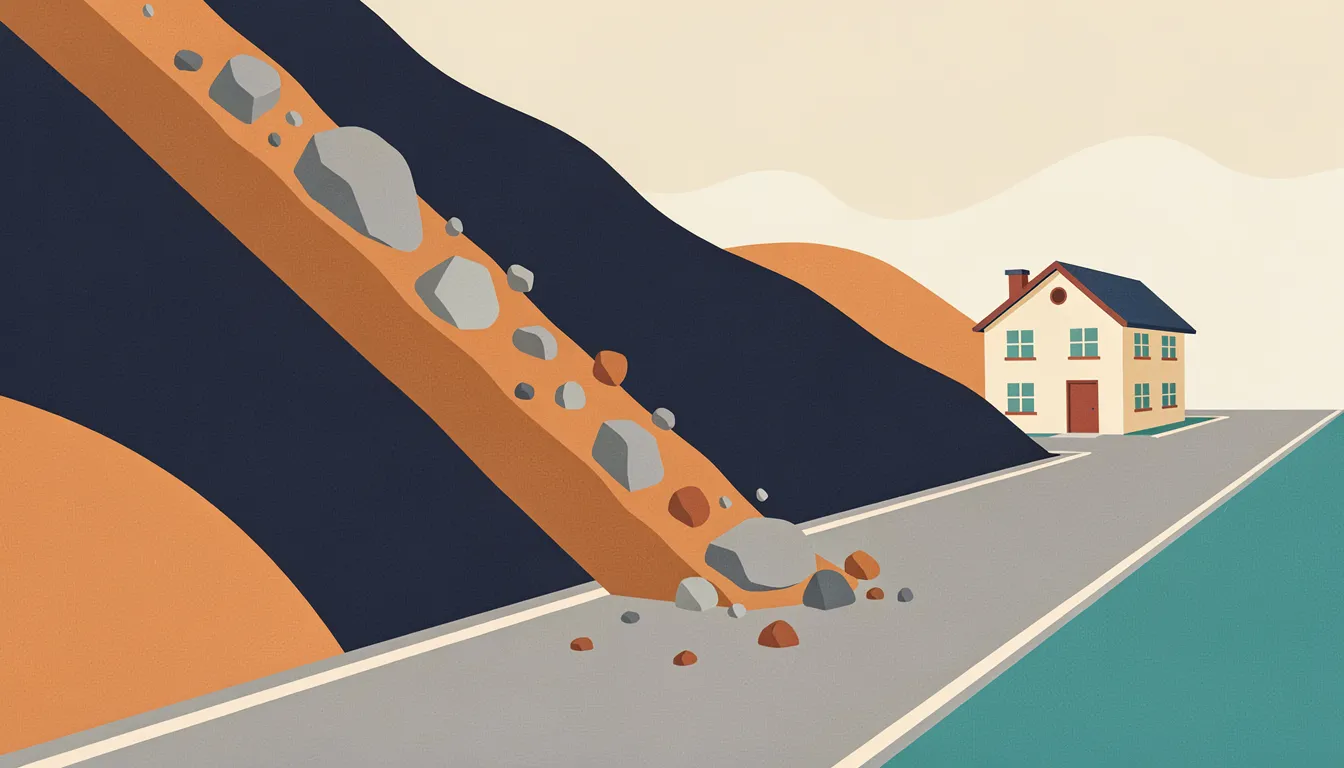
- Watch for cracks, bulges, leaning trees and water changes and identify a route away from the slope.
- Move out of the path immediately, never cross a flow and follow local evacuation instructions.
- Stay away because further movement is possible and technical inspection is needed.
Practical step-by-step guide
A landslide is the movement of rock, soil or debris down a slope. It can be slow and only damage land and homes, or sudden, like mud and debris flows, and then it can be deadly. The most common causes are heavy rain, waterlogged soil, earthquakes, volcanic eruptions and wildfires that have burned a slope: after a fire the risk stays higher for years. A previous landslide is the biggest risk factor for another. When a fast landslide is approaching it is usually too late to escape: the real protection is to know your risk, recognise the warning signs and leave in time, following the authorities.
Before: what to prepare
- Find out from your municipality or local civil protection office whether your home, workplace or school is in a landslide or debris-flow area, especially below steep slopes, in valleys or near slopes burned by wildfire.
- Learn the signs of a slow landslide: new cracks in walls, floors and foundations, doors and windows that start sticking for the first time, tilted trees, poles or fences, bulging ground at the base of a slope, broken pipes or utility lines.
- Learn the signs of a fast landslide: the sound of rushing water, mud or debris coming, trees cracking, boulders knocking together, a faint rumble that grows louder, a stream that suddenly rises, drops or turns from clear to muddy.
- Make a household plan, including pets: where to go, how, and which route to take to higher ground away from the valley. Prepare an emergency go-bag for it.
- Sign up for official alerts and follow the forecasts, especially during heavy rain or if you live near an area burned by wildfire.
- Ask a qualified geotechnical professional to assess your property and advise you. You cannot reliably stop or divert a debris flow: barriers or walls may help against mud and water but guarantee nothing.
- Reduce risk where you can: avoid cutting into steep slopes, keep or plant native vegetation, and direct rainwater from roofs and driveways away from slopes at risk.
During: what to do
- Always follow the instructions of the local authorities: if they tell you to evacuate, do it immediately.
- If you feel it is unsafe, do not wait for an official announcement: leave now. Evacuating is the only sure way to stay safe from a fast landslide.
- Stay alert and awake during a storm that could cause landslides: many deaths occur while people are sleeping.
- Listen to a battery-powered radio and official alerts for updates. Remember that short, intense bursts of rain can trigger landslides.
- Never cross a road with water or mud flowing. Never cross a bridge if you see a flow approaching: it can grow too fast for you to escape.
- Avoid river valleys and low-lying areas during times of danger.
- If you are caught in the path of a landslide, move out of its path as quickly as possible, to higher ground if you can, following local instructions.
- If you cannot escape, curl into a tight ball and protect your head.
- If you are near a stream, watch for a sudden increase or decrease in flow or a change from clear to muddy water: these can be signs that a landslide is coming.
After: getting back to normal
- Stay away from the slide area: more slides may follow.
- Without entering the slide area, check for injured or trapped people and direct trained rescuers to where they are.
- If you evacuated, listen to the authorities to find out whether it is safe to return. Watch for flooding: floods often follow landslides and debris flows because they have the same causes.
- Avoid fallen power lines, poles and wires: they can electrocute you. Report damaged utility lines and broken roads or railways to the authorities so supplies can be shut off quickly.
- Have a professional check the foundation, chimney and surrounding land before you go back in, and ask a geotechnical expert how to reduce the risk. Replant damaged ground as soon as possible: erosion can lead to further landslides.
Mistakes to avoid
- Waiting until you are sure a debris flow is coming: by then it is too late to get away safely.
- Crossing roads or bridges with water or mud flowing.
- Sleeping deeply through a heavy storm in an at-risk area without knowing about alerts and forecasts.
- Entering the slide area to rescue someone: further movement can follow. Call emergency services instead.
- Ignoring new cracks, doors that start to stick or trees that begin to lean, or putting off a professional check.
- Going back home right after the slide without the advice of the authorities and a professional.
- You hear a rumbling, trees or boulders cracking, or you see mud or debris moving: move to higher ground at once and call emergency services when you are safe.
- Someone is injured or trapped near the slide: call emergency services immediately and tell them where, without entering the area.
- You see fallen power lines or poles, damaged pipes, or smell gas: move away and alert emergency services from a safe place.
- Cracks in your home or in the ground are widening quickly, or the ground is shifting: leave immediately and alert the authorities.
- Someone cannot evacuate on their own: alert emergency services or the local authorities right away.
Before: Landslide and debris flow
Watch for cracks, bulges, leaning trees and water changes and identify a route away from the slope.
- Check flood risk, severe-weather advice, your council and the resilience forum or partnership for your nation.
- Include prescriptions, mobility or communication needs, babies, older people, pets and neighbours.
- Store supplies where they are easy to reach and review them every six months or when needs change.
During
Move out of the path immediately, never cross a flow and follow local evacuation instructions.
UK Emergency Alerts can sound on compatible phones without an app. Government will never ask for payment or personal information in an alert.
After
Stay away because further movement is possible and technical inspection is needed.
Fit the plan to the people
Include medication, disability, children, older adults, pets, language, transport and reliance on power or water.
- Bottled water and food that keeps
- Food that does not rely on refrigeration or lengthy cooking
- Manual tin opener and supplies for dietary needs
- Essential medication and a written medicines list
- First-aid and hygiene items
- Baby, disability, mobility and pet supplies
- Battery or wind-up torch and radio
- Power bank, cables and paper contact list
Country information: United Kingdom
Flooding, coastal hazards, storms and utility failures vary by location. Follow instructions from emergency responders and local authorities.
Use Be Ready and your council, then check the correct resilience body: an LRF in England or Wales, an RRP or LRP in Scotland, or an EPG in Northern Ireland. Use the flood-warning service for your nation.
Use 999 or 112 for immediate danger. For urgent, non-life-threatening health help, check the correct NHS service for your nation; Northern Ireland uses local Phone First and GP out-of-hours arrangements.
Frequently asked questions
How do I know a landslide is coming?
With a fast landslide the signs are the sound of water or mud, trees cracking, boulders knocking, a growing rumble or a stream that changes flow or turns muddy. With a slow one you see new cracks, sticking doors, and tilting trees or poles.
What do I do if I get an alert but see nothing?
Follow the instructions of the authorities and, if they tell you to evacuate, go straight away. If you feel it is unsafe, do not wait for an announcement: leaving is the safest protection.
Is the landslide risk higher after a wildfire?
Yes. When a wildfire burns a slope, the chance of landslides rises for several years. If you live near a burned area, sign up for alerts and follow the forecasts.
Can I protect my house from a debris flow?
You cannot stop or change the path of a debris flow. A professional can advise on measures against mud and water, but to protect lives evacuation is often the only option.
Does this guide apply to every situation?
No. It is an organising baseline; the hazard, location and official instructions may require different action.
Official sources
Hours72Kit is independent and does not replace emergency services, government advice or professional support.
Keep your plan close.
Pocket72 will bring personal checklists, household information and review reminders together. Real screens will be added when ready.