Guide contents
Practical overviews to prepare your household, understand hazards and reach the right official local sources.
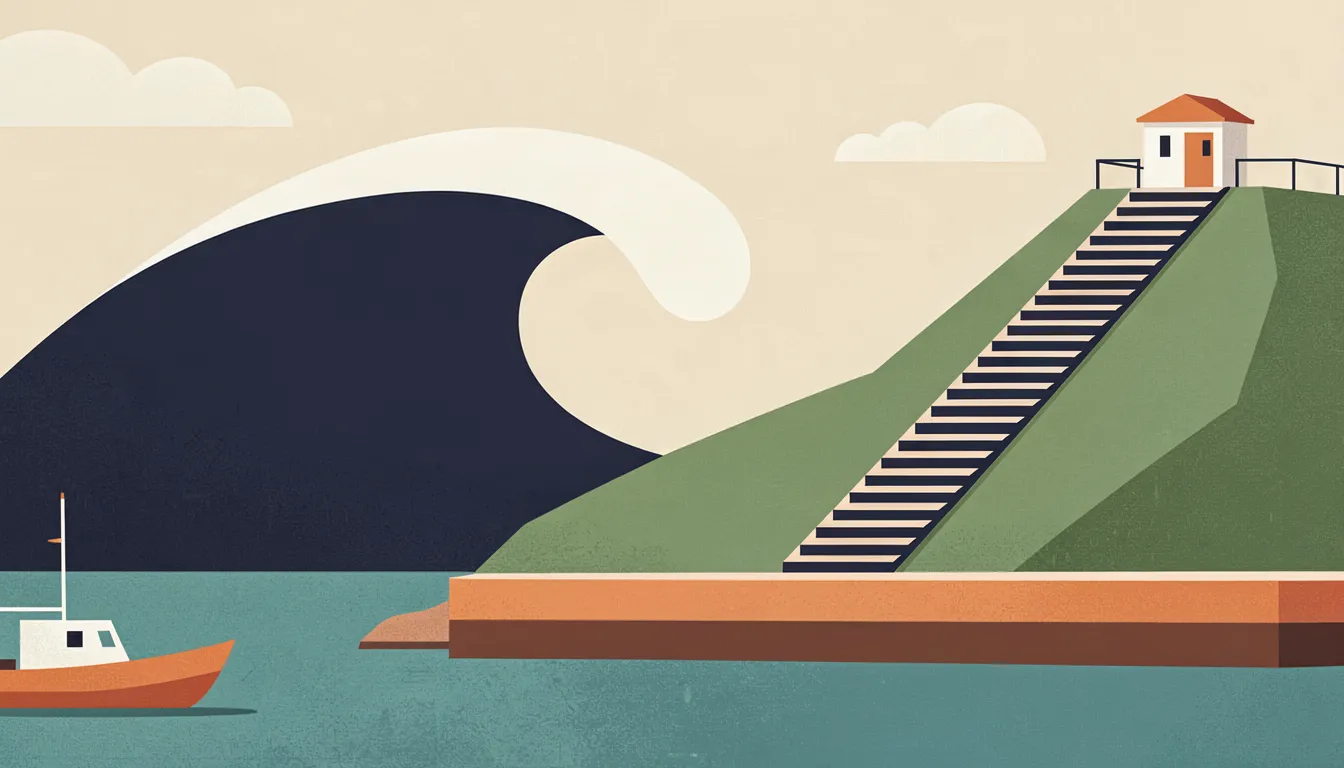
- Know the hazard zone and a walking route to high ground without relying on a car.
- After strong or long shaking, unusual sea withdrawal or an alert, move uphill immediately and stay off the coast.
- Do not return after the first wave; wait for the official all-clear.
Practical step-by-step guide
A tsunami is a series of enormous waves, caused mostly by earthquakes but also by underwater landslides and volcanic eruptions. It is not a single wave: the sea can flood the coast, pull back and return several times over hours. Nobody can predict when or where one will strike, and any coast can be affected. If you live near the sea or spend time there, you have a simple defence: know the warning signs, know in advance where to go, and go straight away, on foot, without waiting. A strong earthquake near the coast, a roar from the ocean or a sudden withdrawal of the water are enough reason to move. This guide tells you what to prepare and what to do.
Before: what to prepare
- Find out whether your home, workplace, school and holiday places are in a tsunami hazard zone by asking your municipality or local civil protection office.
- Learn the natural warning signs: a strong or long earthquake, a loud roar from the ocean, a sudden rise of water or a sudden retreat that exposes the sea floor.
- Learn your community's evacuation plan: some areas have maps with evacuation zones and routes, often marked by signs showing a wave and an arrow pointing to higher ground.
- Map and walk your routes to high ground or inland from home, work and places where you relax. If there is no plan, one reference given by the Red Cross is a place at least 30 metres (100 feet) above sea level or at least 1.6 km (1 mile) inland; local authorities and official signs always take precedence over this figure.
- Agree on a meeting point on high ground and an out-of-area contact with your family; plan how to help people who move slowly and how to take pets.
- Keep a go-bag ready with water, food, medicines, documents, a flashlight, a battery-powered radio and chargers, so you can grab it without losing time.
- Sign up for the official alerts in your area and learn what each alert level means (information, watch, advisory, warning).
During: what to do
- If there is an earthquake and you are near the coast, protect yourself from the shaking first: drop onto your hands and knees, cover your head and neck and hold on until it stops.
- As soon as the shaking stops, if you noticed natural signs or you receive an official alert, move immediately to a place as high and as far inland as possible. Do not wait for the official alert.
- Run on foot by the fastest route to high ground or inland, following signed routes and the authorities. Do not use the car unless you cannot walk: roads clog. Do not waste time collecting belongings.
- If you cannot reach high ground in time, go to an upper floor of a solid concrete building, as high as you can. This is a last resort.
- Stay away from the water, beaches, harbours, river mouths and streams that lead to the sea.
- If you are outside the hazard zone and receive an alert, stay where you are unless the authorities tell you otherwise.
- If you are in the water, grab onto something that floats, such as a raft or a tree trunk.
- If you are on a boat in open water, follow the instructions of the harbour authorities: usually you head out to sea; if you are in a harbour, go inland.
- Listen to the radio, official alerts and the authorities. Do not go back until they say it is safe: waves can arrive several times and continue for hours.
After: getting back to normal
- Stay where you are safe until the authorities say you can return, or tell you to move even further inland. If damage is severe it can take days.
- Do not touch or wade into floodwater: it can contain debris, sewage and chemicals, and can be deeper than it looks. Avoid roads that were flooded; they may be damaged.
- Stay away from fallen or buried power lines: assume they are live, because they can electrify water. Keep away from damaged buildings, roads and bridges.
- Inspect the outside of your home only when the authorities allow it. If it is damaged, it is safer to wait for a professional. Use battery-powered lights, not candles, and never use generators or gas, charcoal or petrol stoves inside a home, garage or tent: carbon monoxide can kill.
- Ask the local health authority about drinking water safety. Throw away food that got wet or warm, and clean and disinfect everything that touched mud. Photograph damage for your insurance.
- Use text messages instead of calls to reach family and keep the lines free for emergencies.
Mistakes to avoid
- Waiting for an official warning after strong shaking or after seeing the sea pull back: those signs are enough to leave.
- Going to look at the receding sea or to photograph the waves: the water can return within minutes.
- Thinking it is over after the first wave and going back too early: there can be more than one wave and they can continue for hours.
- Wading into floodwater or touching wet electrical equipment.
- Wasting time collecting belongings before leaving.
- Driving away by car: roads clog and the wave can catch you. Go on foot if you can.
- You are seriously injured, or someone is not breathing or is bleeding heavily: call emergency services immediately.
- You were swept up by the water and feel intense cold, confusion or weakness: get medical help right away.
- You see fallen power lines or flames, or smell gas: move away and alert emergency services from a safe place.
- You have a headache, dizziness or weakness while using stoves or generators: get everyone into fresh air and call emergency services.
- Someone cannot move on their own and you cannot help them reach higher ground: alert emergency services immediately.
Before: Tsunami
Know the hazard zone and a walking route to high ground without relying on a car.
- Check flood risk, severe-weather advice, your council and the resilience forum or partnership for your nation.
- Include prescriptions, mobility or communication needs, babies, older people, pets and neighbours.
- Store supplies where they are easy to reach and review them every six months or when needs change.
During
After strong or long shaking, unusual sea withdrawal or an alert, move uphill immediately and stay off the coast.
UK Emergency Alerts can sound on compatible phones without an app. Government will never ask for payment or personal information in an alert.
After
Do not return after the first wave; wait for the official all-clear.
Fit the plan to the people
Include medication, disability, children, older adults, pets, language, transport and reliance on power or water.
- Bottled water and food that keeps
- Food that does not rely on refrigeration or lengthy cooking
- Manual tin opener and supplies for dietary needs
- Essential medication and a written medicines list
- First-aid and hygiene items
- Baby, disability, mobility and pet supplies
- Battery or wind-up torch and radio
- Power bank, cables and paper contact list
Country information: United Kingdom
Flooding, coastal hazards, storms and utility failures vary by location. Follow instructions from emergency responders and local authorities.
Use Be Ready and your council, then check the correct resilience body: an LRF in England or Wales, an RRP or LRP in Scotland, or an EPG in Northern Ireland. Use the flood-warning service for your nation.
Use 999 or 112 for immediate danger. For urgent, non-life-threatening health help, check the correct NHS service for your nation; Northern Ireland uses local Phone First and GP out-of-hours arrangements.
Frequently asked questions
Should I wait for an official warning before leaving?
No. If you feel a strong earthquake, hear a roar from the sea or see the water suddenly pull back, move to high ground or inland immediately. An official warning may come late or not at all.
What distance or height is safe enough?
Follow the evacuation zones given by the local authorities. If there is no plan, one Red Cross reference is a place at least 30 metres (100 feet) above sea level or at least 1.6 km (1 mile) inland.
How long do I stay away from the coast?
Until the authorities say it is safe to return. A tsunami can be a series of waves and the danger can last for hours, sometimes more than a day.
What do watch, advisory and warning mean?
In general, a low level means stay informed, a middle level means stay out of the water and off beaches and follow the authorities, and the highest level means move to high ground or inland immediately. The names of the levels vary from country to country: learn the ones for yours.
Does this guide apply to every situation?
No. It is an organising baseline; the hazard, location and official instructions may require different action.
Official sources
Hours72Kit is independent and does not replace emergency services, government advice or professional support.
- Ready.gov: Tsunamis ↗
- American Red Cross: Tsunami preparedness ↗
- US National Weather Service: Tsunami safety ↗
- UNESCO: Tsunami Ready programme ↗
- GOV.UK Be Ready — hazards ↗
- Be Ready — prepare for emergencies ↗
- UK Emergency Alerts ↗
- Local resilience bodies across the UK ↗
- Ready Scotland ↗
- NI Direct — be ready for emergencies ↗
- Check flood risk ↗
- Met Office weather warnings ↗
Keep your plan close.
Pocket72 will bring personal checklists, household information and review reminders together. Real screens will be added when ready.